Beyond FinTech: How RegTech and SupTech Can Transform Kenya’s Financial Sector
For over a decade, Kenya’s fintech story has been told through one lens: mobile money. M-Pesa turned a country with limited bank branches into a case study that the World Bank and central banks everywhere still cite. But walk into any regulatory meeting in Nairobi today and the conversation has quietly shifted. It is no longer just about who can build the next payment app. It is about who can keep watch over the hundreds of apps that already exist, making sure the money moving through them is clean, safe, and traceable. That shift is opening a gap most people outside the industry have not noticed yet: a shortage of RegTech and SupTech specialists. In plain terms, these are the people who build the software that banks use to stay compliant, and the software that regulators use to keep an eye on the whole financial system, so that digital finance stays safe without becoming so restrictive that it locks people out.
A Market That Outgrew Its Guardrails
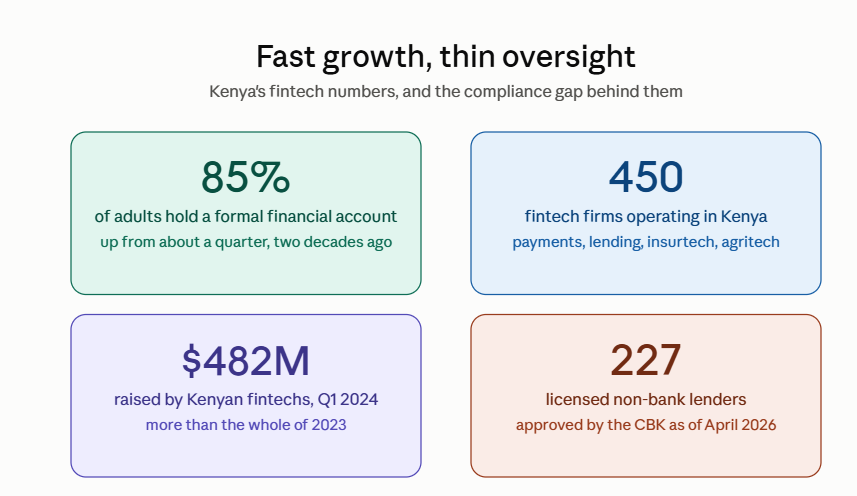
Kenya’s numbers are genuinely impressive. Roughly 85% of adults now hold a formal financial account, up from about a quarter of the population two decades ago (The Fintech Times, 2026), and the country is now grouped with Nigeria, South Africa, and Egypt as one of Africa’s four dominant fintech hubs, home to an estimated 450 fintech firms spanning payments, lending, insurtech, and agritech (The Fintech Times, 2026). Venture capital has followed: Kenyan fintechs pulled in $482 million in the first quarter of 2024 alone, more than the whole of the previous year (SDK.finance, 2026). Yet growth this fast has consistently outpaced the state’s ability to keep watch over it. Legal analysts tracking Kenya’s rules note that the country still does not really have a RegTech industry of its own, and that oversight has generally followed innovation rather than getting ahead of it (Chambers and Partners, 2026).
The clearest evidence is what happened with the Financial Action Task Force, the global body that tracks how well countries fight money laundering and terrorism financing. In February 2024, it placed Kenya on its ‘grey list,’ a public watchlist for countries judged not to be doing enough, citing weak prosecution of money-laundering cases, thin oversight of crypto businesses, and gaps in knowing who really owns and controls companies operating in the country (Trigarc, 2026). More than two years on, Kenya is still on that list, even as it races toward an exit it now targets for May 2026 (Capital Business, 2026). Tellingly, the Financial Reporting Centre, the government unit meant to police illicit money flows, says its own budget was cut to a fraction of what it needs to actually operate (Trigarc, 2026). Being grey-listed is not just a diplomatic embarrassment; it makes every cross-border payment a Kenyan bank handles slower and pricier, since foreign banks double-check it more carefully, and it makes investors wary of compliance risk.
Regulation Is Catching Up, Fast
To its credit, Kenya has stopped reacting piecemeal. A new law, the Virtual Asset Service Providers Act, was signed in October 2025 and brought crypto exchanges and wallet providers under formal licensing for the first time, bringing Kenya closer to international rules for crypto businesses (Binar, 2026). The Central Bank of Kenya (CBK) has, at the same time, overhauled how it licenses lenders that are not full banks, replacing the old “digital credit provider” label with a broader category, and by April 2026 had approved 227 such firms (Techpoint Africa, 2026; Businessfront, 2026). None of these rules enforce themselves, though. Approving 227 lenders and dozens of crypto firms means someone has to keep watching all of them, for warning signs of money laundering, predatory lending, and weak cybersecurity, at a scale the CBK’s own inspectors simply cannot cover by hand.
Why the Gap Belongs to People, Not Just Policy
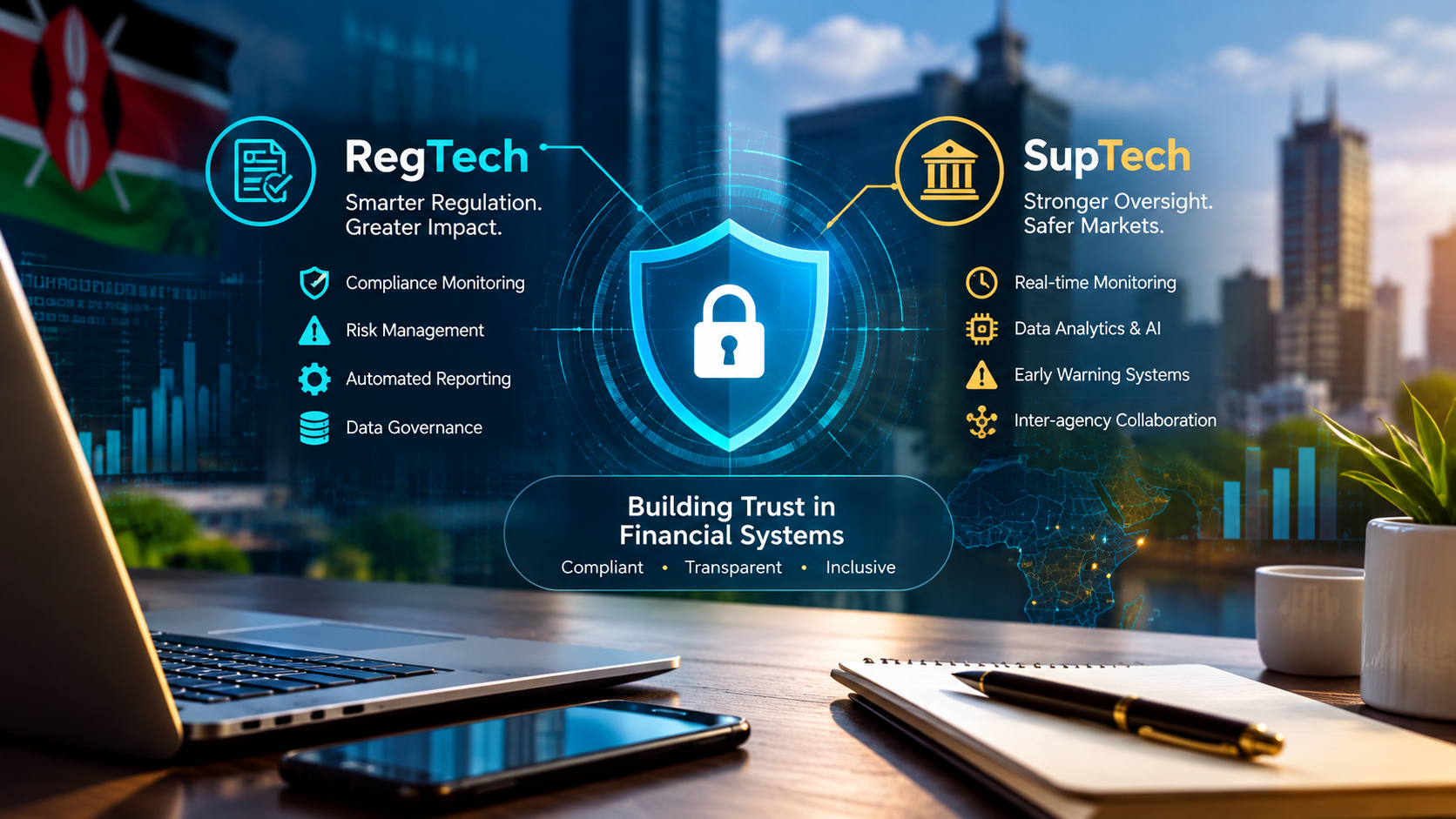
This is exactly where RegTech and SupTech come in. RegTech, short for regulatory technology, is the software banks and fintech use to automate the essential parts of compliance: checking who a customer really is, flagging unusual transactions, and filing the right reports. SupTech, short for supervisory technology, is the same idea from the regulator’s side: the tools a central bank uses to watch the financial system live, instead of waiting for the next scheduled inspection. The Alliance for Financial Inclusion argues these tools are central to expanding financial access responsibly in developing economies, since they let regulators keep pace with new products without shutting innovation down or losing track of it (Alliance for Financial Inclusion, 2024). Kenya clearly has the appetite to regulate. What it is missing is people fluent in both sides: professionals who can design a system that catches suspicious money movements, turn a new CBK rule into a process a compliance team can actually follow, or build a dashboard that lets a supervisor spot a struggling lender before it fails. That shortage already shows in the training market: regional programmes for central bank staff are now built explicitly around RegTech and SupTech skills, a sign institutions across the continent, Kenya included, are importing this expertise rather than drawing on deep local talent (Skills for Africa, n.d.).
What This Means for the Next Wave of Careers
For young Kenyan professionals in law, data science, computer science, and finance, this is the opening. The country does not need more people who can build a payment app; it already has hundreds of those. It needs people who can build the systems that keep those apps honest: engineers who design the compliance software itself, analysts who track how money moves and flag what looks wrong, and specialists who help regulators supervise digital finance without slowing it to a crawl. The banks and fintechs that invest in this talent early, rather than treating compliance as an afterthought handled only once a regulator complains, will be the ones best placed to operate with confidence once Kenya exits the grey list and competes for the next wave of serious international investment.
Financial inclusion in Kenya was won once already, through mobile money and a willingness to let innovation run ahead of regulation. The next chapter will be won differently: by the people who can make sure that innovation is supervised well enough to be trusted.